

Season opening with new design April 1st
This winter we have renewed the entire exhibition in the museum. Among other things, with a new interactive exhibition about global warming!
From April 1st you can experience the Norwegian Glacier Museum in a new look. Opening hours are 10:00 - 16:00.
We have already kicked off the season at Easter with visits from groups, events at Fjærland Sogelag and open to all on Easter Sunday.
The snow is still on the ground around the museum, which means that the educational playground is not yet fully ready for use. But with the renovated and upgraded main exhibition, with a new design and refreshed colors, as well as the film about Jostedalsbreen by Ivo Caprino and the fantastic climate exhibition, we are ready for an exciting and educational visit.
Welcome to the Norwegian Glacier Museum season 2016!
PS: this year we celebrate our 25th anniversary.

Open Easter Sunday!
On Easter Sunday, the Norwegian Glacier Museum is open from 11:00 AM to 5:00 PM.
Otherwise, we will open our doors for the season on April 1st. Opening hours are 10:00 - 16:00.
Meet us at the Norwegian Glacier Museum

Merry Christmas & Happy New Year
Welcome back to the Norwegian Glacier Museum in Fjærland in 2016. We will reopen the museum on April 1st, with exciting upgrades to the museum!
And remember: in 2016 we have our 25th anniversary.
Director John Brekke

Breane's front position changes in 2015
In the autumn, the Norwegian Glacier Museum carried out the annual front position measurements on some glaciers in the local area.
Bøyabreen and Store Supphellebreen have been part of the measurement program since 2003 and 1992 respectively. We have carried out the measurements on the regenerated parts of the glaciers that lie at the foot of the mountain during the glacier fall. The glaciers have been difficult to measure in recent years as avalanches and ice slides control how these masses change, and it is not always that we find blue ice when we measure them. In addition, the glaciers are melting again due to increased average temperatures. It has not been possible to measure Bøyabreen and Store Supphellebreen accurately enough this year, which means that we do not get figures on the front position changes. This is a problem we have been waiting for in recent years and it now appears that we will have to end the measurement series.
The Bøya glacier in Fjærland, October 2015. (photo: Pål Gran Kielland).
It is not just the glaciers in Fjærland that are difficult to measure. Senior engineer at NVE, Hallgeir Elvehøy, had this to say about the status of the measurements: "It is a shame to interrupt measurement series, but if the measurements are not representative of glacier development, then there is no other option. We are considering terminating Briksdalsbreen..." For Briksdalsbreen, there is a measurement series dating back to 1901 that is now in danger of also having to be interrupted.
Briksdalsbreen in autumn 2013 seen from the top of Oldeskaret (Photo: Pål Gran Kielland).
But fortunately we have two other glaciers that we can still measure the front position of. These are Vetle Supphellebreen and Haugabreen. Here we measure directly on the blue ice in the glacier fronts. Vetle Supphellebreen advanced 8 meters and since we started measuring the glacier in 2011 it has retreated a total of 14 meters. We cannot draw conclusions about the development of the glacier from year to year, since glaciers have a delayed reaction time in a hot climate, but the results since 2011 fit in with the trend we have with a warming climate and shrinking glaciers over time. We actually have good evidence of this trend, since there are old measurements with a fairly long measurement series from 1899 to 1944 where the glacier retreated over 400 meters. We also found an old picture from 1884 where you can clearly see that there were larger ice masses before, which shows that the climate has become warmer in modern times.
Vetle Supphellebreen in 1884 (photo: Steensrup, KJD) and 2015 (photo: Pål Gran Kielland).
Measurements of the front of Haugabreen show a retreat of 7 meters in 2015. We only have two years of measurements, but the figures show that the glacier has melted a total of 20 meters back. Here too, we cannot draw conclusions about the development of the glacier with such a short series of measurements, but we can look back in time when there are actually measurements of Haugabreen all the way back to the period 1933 - 1940. At that time, it was Anders Briksdal who measured the glacier, and he recorded that it melted 237 meters back during these years. The fixed point from which he measured the distance to the glacier was a cairn on a large rock on the east side of the river in Haugadalen. This was natural since he came over Oldeskaret from Briksdalen. He described, among other things, that the lower part of the glacier tongue was completely flat, which could indicate that the glacier tongue was quite thin and in decline. Based on these old measurements, the glacier edge in 1939 was probably located on the flats in Haugadalen, before the rock rises steeper towards today's glacier front.
Haugabreen glacier in the 1930s (photo: NGU) and in 2012 (photo: Pål Gran Kielland).

Mountaingoat Guiding in Fjærland
Mountaingoat guiding is a small business based in the small and beautiful village of Fjærland, which lies in the heart of nature in Sogn og Fjordane.
The Sjølvaste Mountaingoat on its way up an ice pinnacle on the glacier. Photo: Gaute D. Bøyum.
Owner Gaute Dvergsdal Bøyum grew up with glaciers, fjords and mountains right outside his door and has a good knowledge of this. He would be happy to take you on a trip to give you unforgettable experiences in nature!

The School's Climate Report
In collaboration with Firda secondary school, Sogn og Fjordane county council, 4H and United World College, we will develop a teaching program where teachers take students out into nature and the school's immediate environment.
The Norwegian Environment Agency is providing 60,000 kroner to the project "School Climate Report". The money has been provided through the Natural School Bag . The project will increase the competence of both students and teachers when it comes to sustainable development, with particular emphasis on the climate perspective.
High school students observe the Supphellebreen glacier in Fjærland during a field trip. Photo: Monica Østbye Hansen.
– The goal is to make students more aware of the local consequences of global warming, and what we can do for climate adaptation and sustainable development and restructuring in society. We are pleased that the Norwegian Environment Agency sees the value of this and are looking forward to getting started with the project in earnest, says John Brekke, director of the Norwegian Glacier Museum & Ulltveit-Moe Climate Center.
The teaching program emphasizes practicality – students go out into nature to learn. Concrete, local issues, exploratory working methods and a practical approach are central. The principal of the pilot school Firda vidaregåande skule, Hallgeir Hansen, believes that knowledge and insight into climate issues are becoming increasingly important for being able to participate actively in social life.
– The “green shift” in politics, economics and social development requires new knowledge, new jobs, new technology and new values for future generations. The Ludvigsen committee outlines the need for new subject combinations and greater emphasis on in-depth learning to give students the right skills for the future. Gloppen aims to be a pioneer municipality in testing climate and environmental education in primary and secondary schools, and we therefore look forward to being a pilot for the “School Climate Report”, says Hansen.
An example of practical teaching in nature; lively communication and adapted excursion booklets with questions that deal with natural geography, glaciology and climate knowledge. Photo: Norwegian Glacier Museum.
The pilot project will be a multidisciplinary project to increase knowledge about climate and the environment for students in their first year of upper secondary school. It will also be an important foundation for a larger effort to develop a new program subject for the study specialization education program at upper secondary schools.
It is natural to involve science, social studies, geography, mathematics, Norwegian and physical education in the project, which should also have value for the school in the long-term learning work. The upper secondary school will be involved from the start, but the project should also have transfer value to other schools, with the possibility of local adaptations.
In the long term, the goal is to adapt the project to grade levels in elementary school.
Concert at Brævasshytta
On Saturday, September 5th, there will be a free concert with Torbjørn Dyrud at Brævasshytta, which is located in front of the mighty Bøyabreen glacier.
The concert starts at 2:00 PM.
You can find a link to the event on Brævasshytta's Facebook page here .
Book night in Fjærland
The Norwegian Book City in Fjærland is organizing the annual Book Night on Saturday, June 20th.
See the Book City website for the program.
Welcome!
Unveiling of new exhibition and official opening of the season at the Norwegian Glacier Museum
Day and time: Saturday, May 23 at 11:30 AM.
This year's novelty is a gigantic jigsaw puzzle with Jostedalsbreen National Park as the theme. In addition, in 2015 we installed a new kitchen in the café, and not least we have translated the museum into two new languages, Polish and Dutch. With these two, we are now up to 13 languages in the entire museum.
The unveiling, including local music and speakers, will last a maximum of half an hour. Afterwards, we invite you to some simple food and pleasant mingling.
There will be free sausages, juice and coffee/tea for everyone =)
With best regards
The Glacier Museum People
New season at the Norwegian Glacier Museum
There is still snow around the museum, about 50 centimeters on flat ground, but we will soon start a new season.
From April 1st, the Norwegian Glacier Museum is open every day 10:00 - 16:00. Click here for prices and opening hours.
Welcome to the Norwegian Glacier Museum in 2015!

25th anniversary
Stiftinga Norsk Bremuseum & Ulltveit-Moe center for climate science turns 25 and organizes a climate seminar in Oslo on:
"Sea level rise as a consequence of glacial melting – what do we actually know?"
On Friday, January 16, prominent climate scientists, Norwegian professors Jon Ove Hagen, Jan Mangerud and Atle Nesje, and Jason Box from the Geological Survey of Denmark, will meet at the Academy of Sciences and Letters to share the latest news about future sea levels.
Norwegian Glacier Museum on a typical idyllic summer day in Fjærland. Photo: Gaute D. Bøyum 2014.
In addition to the climate scientists, Jens Ulltveit-Moe will talk about "inspiring communication as a key to political action", State Secretary Lars Andreas Lunde of the Norwegian League of Liberals and Democrats for Europe will give a presentation on "climate policy and societal change", and Camilla Schreiner from the Research Council of Norway will talk about climate research and climate communication.
Dr. Olav Orheim, chairman of the board of the Norwegian Glacier Museum, glaciologist, climate scientist and former director of the Norwegian Polar Institute, will tell the story of the Norwegian Glacier Museum - one of Norway's most successful initiatives in glacier and climate communication.

Glaciers melted a lot in 2014
The Norwegian Glacier Museum has carried out annual measurements of the frontal position of four glaciers. 2014 will be a bad year for the glaciers.
For several years we have measured changes in length on glaciers in Fjærland. It started with Store Supphellebreen in 1992 while we started with Bøyabreen in 2003. In recent years these glaciers have decreased, which has meant that we have started measurements on two more glaciers. These are Vetle Supphellebreen which we started measuring in 2011 and Haugabreen (in Jølster) last year.
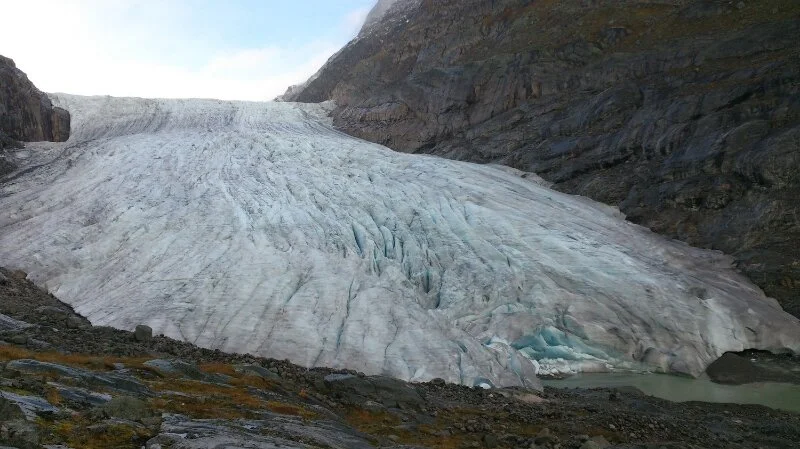
Haugabreen glacier October 2014. Photo: Pål Gran Kielland.
The results from the measurements all point in the same direction:
Store Supphellebreen -18 meters
Bøyabreen -65 meters
Vetle Supphellebreen -31 meters
Haugabreen -13 meters
While the measurements of Vetle Supphellebreen and Haugabreen are made directly on active glacier arms, the measurements of Store Supphellebreen and Bøyabreen are made on regenerated glaciers. That is, glaciers that have been formed by ice slides and avalanches from the glacier and the mountain above them. The regenerated glaciers can therefore vary somewhat depending on where the slide occurs. This year, little avalanche activity has been observed, so the regenerated glaciers have not been able to gain much weight. In addition, the melting season has been warmer than normal and they are not particularly high above sea level; Bøyabreen 150 m and Store Supphellebreen 60 m. The result is that they are shrinking, especially Bøyabreen by 65 meters while Store Supphellebreen retreated 18 meters.
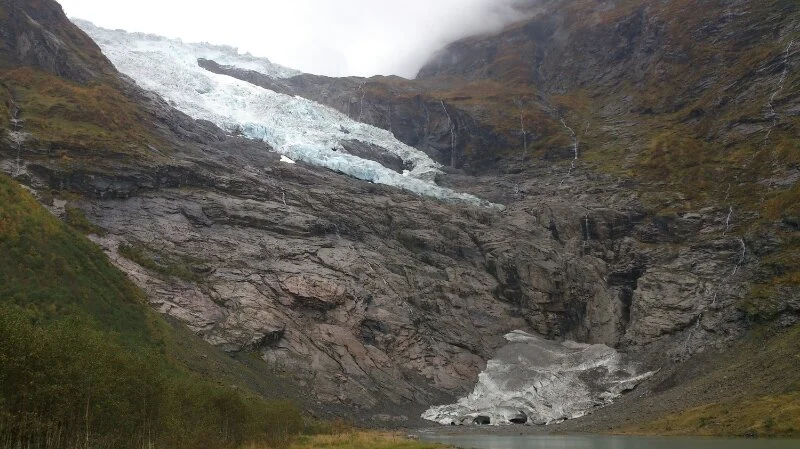
Bøyabreen October 2014. Photo: Pål Gran Kielland.
The fronts we are measuring on Haugabreen and Vetle Supphellebreen are located higher up in the mountains than the regenerated glaciers and should therefore be more robust against summer melting. Haugabreen (about 900 m) retreated 13 meters, while Vetle Supphellebreen (about 750 m) decreased by 31 meters. These figures show that the warm summer has also eaten away at the ice higher up in the mountains in 2014, which has been observed in several places. Among other things, in the area above the start of the glacier fall (1200 m) to Bøyabreen, old blue ice has melted at an altitude of 15-1600 meters.
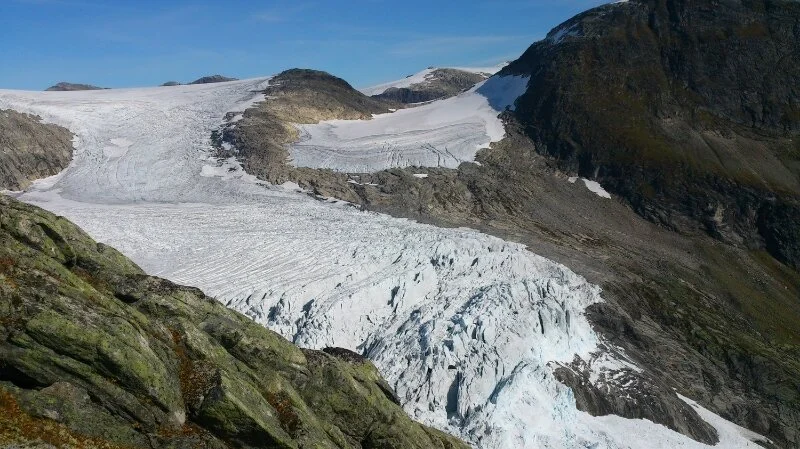
The glacier collapse of Bøyabreen in September 2014. Photo: Pål Gran Kielland.
The measurements are made for NVE (Norwegian Water Resources and Energy Directorate).

Round bale festival 2014 Saturday 30th August
Summer is in full swing, but in the glacier village of Fjærland, the festivities continue with the very special Rundballe Festival. Here, art and culture come together with exciting activities where roundball-covered huts meet glaciers, magnificent mountains and a deep fjord.
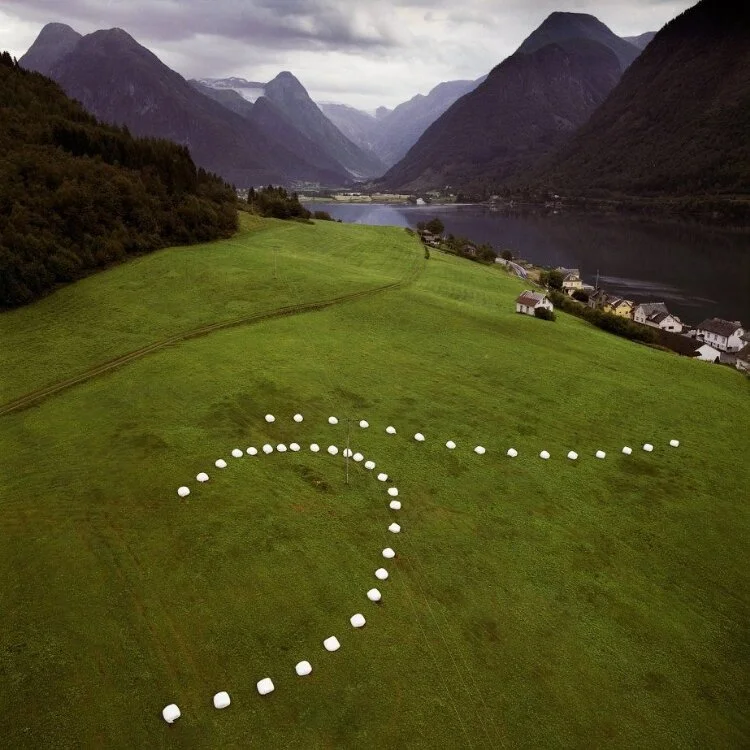
Photo: The Round Ball Festival.
The festival is a sight in itself, with the Roundball World Championship as perhaps the biggest highlight!
For more information, see Rundballefestivalen on Facebook.

Blogging about blue ice
Blue ice is one of the most beautiful things the eye can see. 20 years ago, a guest at the Norwegian Glacier Museum was taken aback by the glacier tongue illusion in the exhibition:
"My first encounter with a glacier was in an artificial glacier tongue at the Norwegian Glacier Museum in Fjærland. The glacier at the glacier museum was cold, the ground I was walking on was uneven, and I could hear the ice melting and the glacier moving. Since then I have been fascinated by glaciers, but it was only this summer, 20 years later, that I got to experience a real glacier."
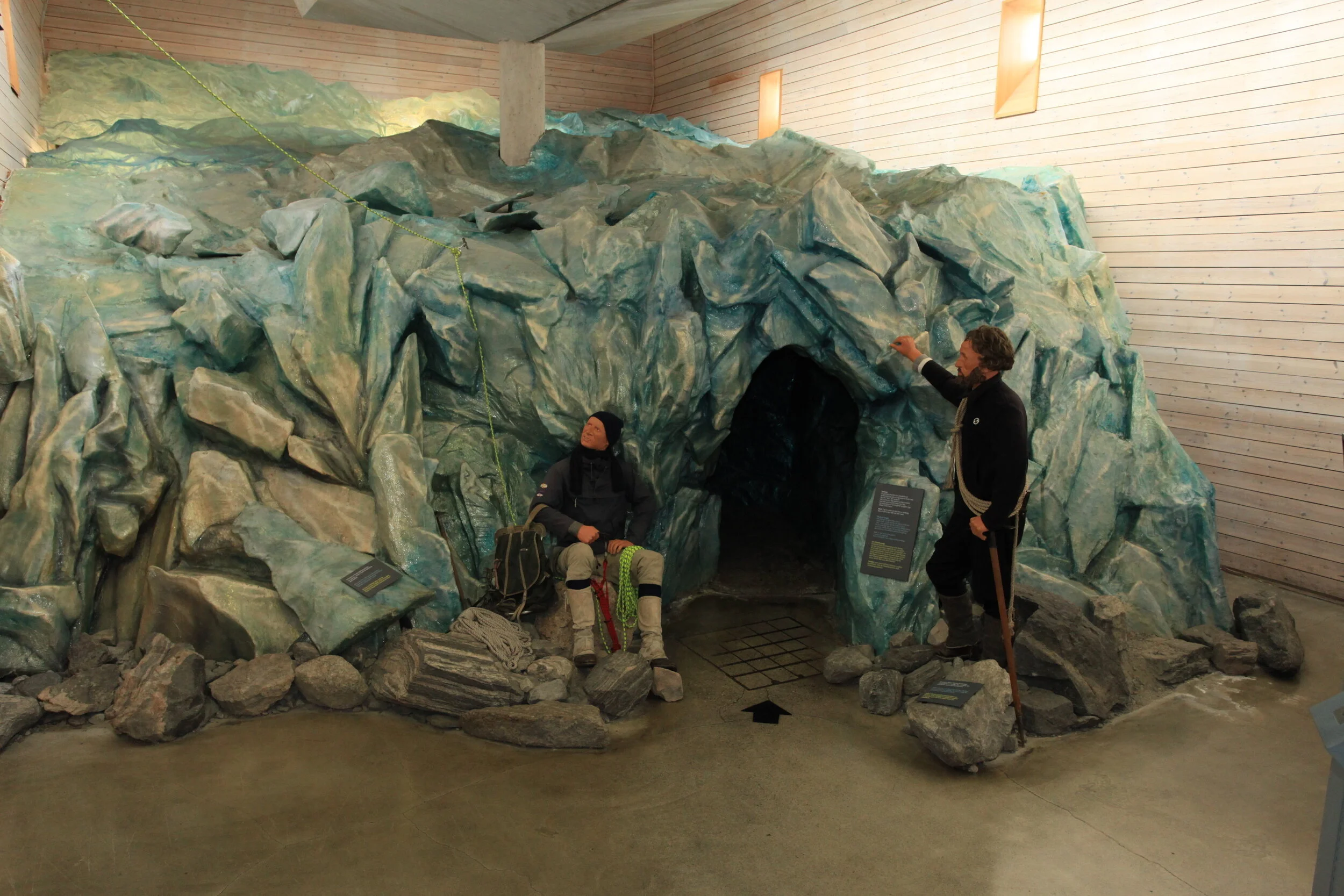
Glacier tongue in the Norwegian Glacier Museum. Photo: Gaute D. Bøyum 2013.

Trip to Myrhaugsnipa with Sogndal Turlag Saturday August 9th
Myrhaugsnipa (1443 m) is located inside Flatbrehytta in Fjærland, see the red arrow in the picture. This is a trip that is run in collaboration between Sogndal Turlag and the Norwegian Glacier Museum. Glaciologist, foreigner and professor Olav Orheim is on board as a tour guide and expert.
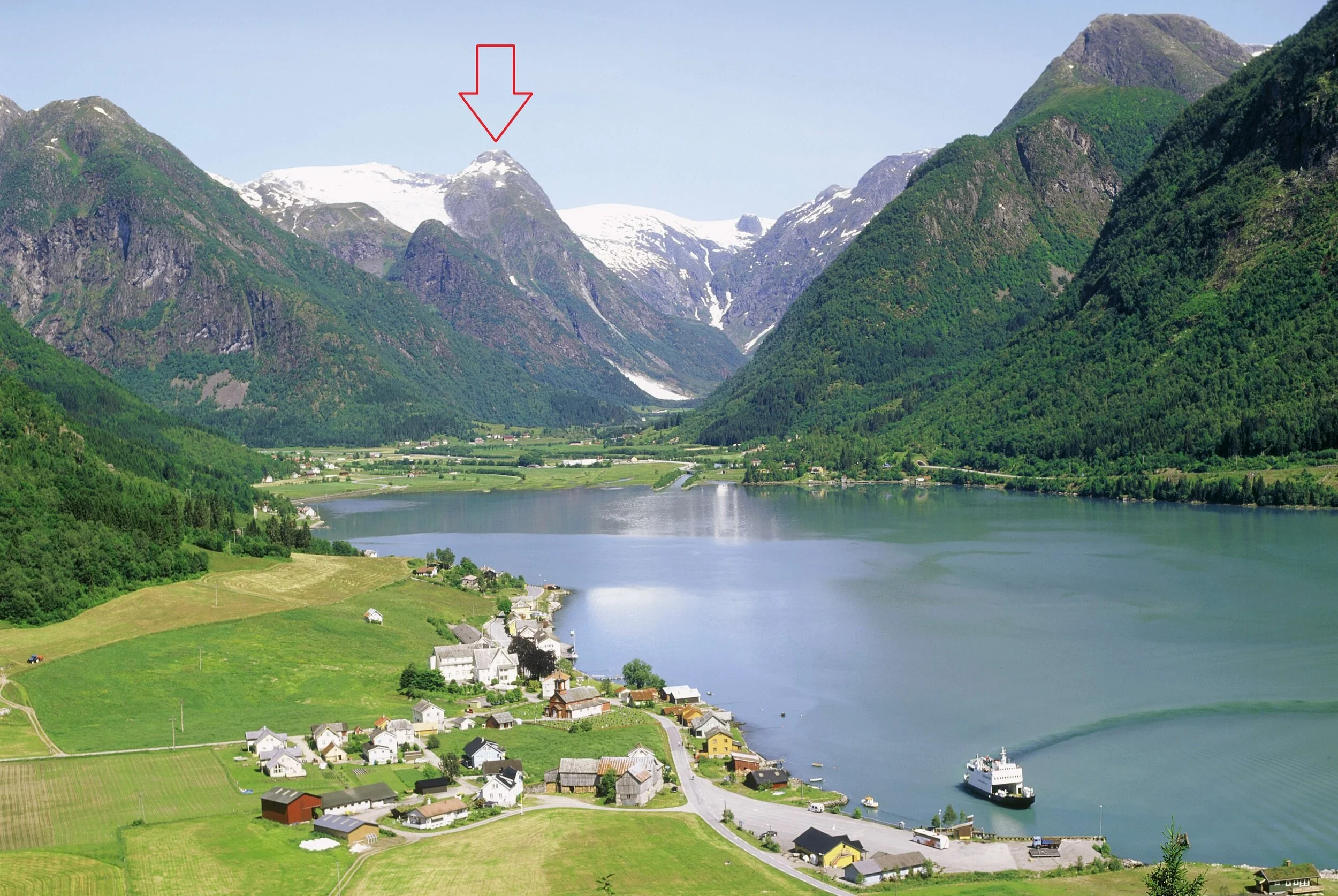
It is a long hike with a total elevation gain of 1400 meters and a minor glacier crossing. But as a reward you get an incredibly beautiful view over Supphellebreen and out into Fjærlandsfjorden. The hike is strenuous and is expected to take around 8 hours.
Meet at Almenningen in Sogndal at 08:30 and depart from the parking lot at Øygard at 09:15. Please contact the hiking team by Thursday 7 August if you would like to borrow glacier equipment (climbing gear and ice axe).
Map: Turkart Sogndal-Leikanger or 10055 Sogndal in the Norway series.
Tour guides: Pål Kielland (461 97 627) and Olav Orheim.

Ice Music concert at the Norwegian Glacier Museum
On July 17th, there was a great concert at our place, where musicians played instruments made of ice.
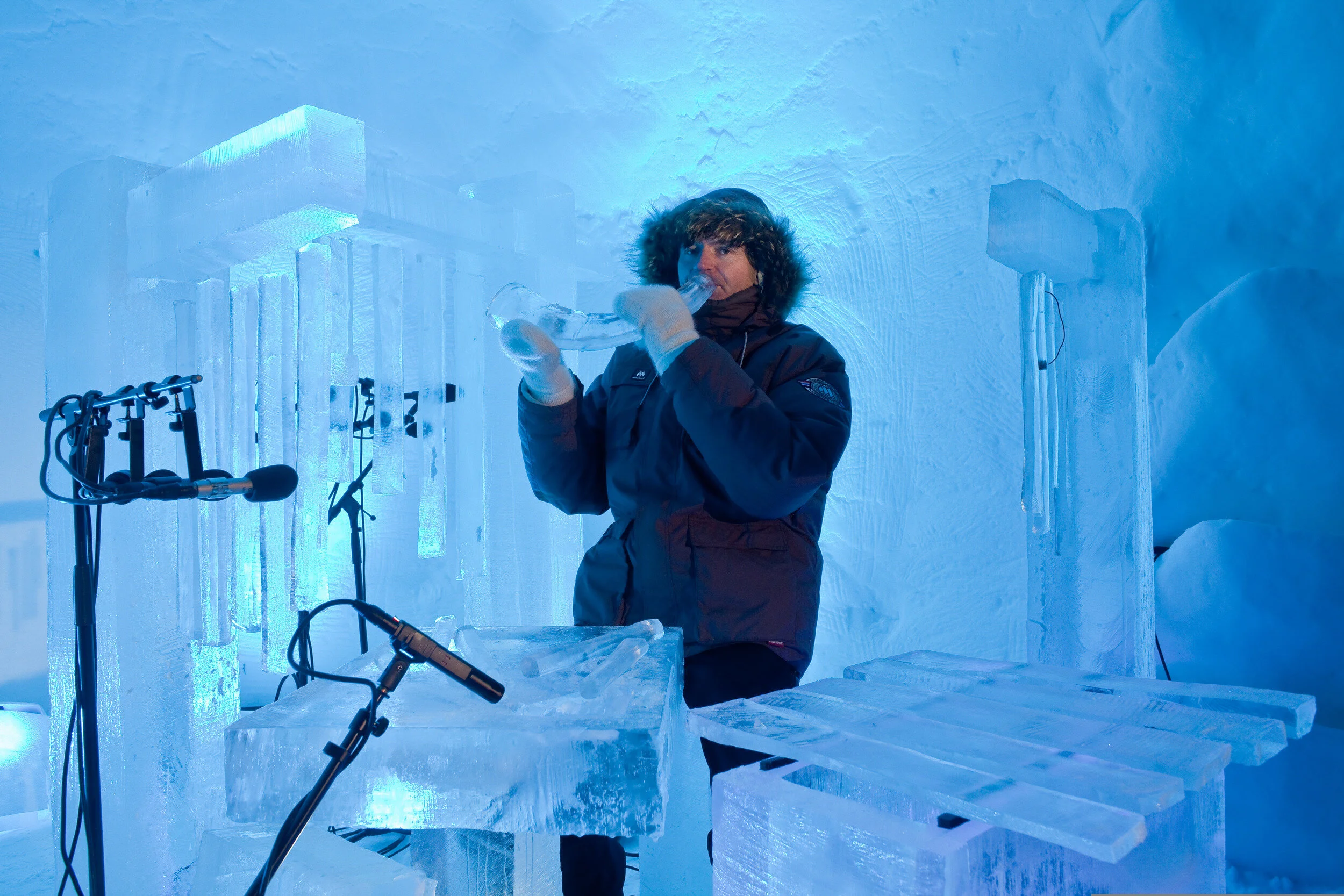
Terje Isungset and Ice Music came to create a magical evening on the terrace in the garden of the Norwegian Glacier Museum. They even had a freezer truck filled with large instruments made of ice.
Among other things, Isungset wanted to check the sound of the Jostedals glacier and a special horn of ice from the glacier was made just for this concert.

Opening hours in summer
The Norwegian Glacier Museum is open every day from 9 am to 7 pm in June, July and August.
We hope you'll visit us this summer =)
Beautiful summer day outside the Norwegian Glacier Museum.
Warm summer greetings
Everyone at the Norwegian Glacier Museum

Opening party for the educational playground
On Ascension Day, May 29th, there will be a new opening party at the Glacier Museum with the unveiling of the educational playground. Previously, we have had a mammoth family towering on the lawn in front of the museum. Now comes the final part of the playground, which is aimed specifically at children, but which we hope will also appeal to adults.
There will be free admission, ice cream for the children, cake and coffee for the adults, and entertainment.
The event starts at 11:30.
Welcome =)
Meet us at the Norwegian Glacier Museum in Fjærland


Season starts April 1st
Tuesday, April 1st, the Norwegian Glacier Museum opens for the new season. We are open every single day 10:00 - 16:00. Weekends and public holidays included.
This year, new outdoor exhibitions and renovations inside the museum are on the way. Follow us on our website, or on social media such as Facebook , Instagram and Twitter .
The Norwegian Glacier Museum welcomes you to the 2014 season! Here you will find mammoths, a polar bear, a great panoramic film about the Jostedals Glacier, interactive exhibitions and real glacier ice.
Mammoths. Photo: Gaute Dvergsdal Bøyum.